
Marketing Automation Strategy: More Leads, Less Effort

Every business could use more customers. But that means more marketing work.
Do you really have the time to post on social media, write thought leadership, manage paid campaigns, and organize a flash mob at your local industry expo?
Possibly. But you’ll probably have to leverage marketing automation.
Automation is not delegating everything to robots. It’s more about using tools to extend what you currently do, without increasing your workload.
Sounds great! Time to sign up for ten subscriptions! Actually, no…
The marketers who see the greatest benefits from automation tend to build a rock-solid strategy before taking action.
In this quickstart guide, we’ll show you how to follow suit — from identifying the best areas to automate, to choosing your tools.
Let’s dive in!
Why You Need a Marketing Automation Strategy
Companies that see the best outcomes from marketing automation tend to have a strategy in place. They think carefully about what can be automated, and just as importantly, what can’t or shouldn’t be automated.
They also know what they want to achieve, which tools will help them hit those goals, and how to measure their progress.
Working through the same mental process puts you in a strong position to succeed with your own marketing automation efforts.
Let’s do it together, step by step.
What Are You Trying To Achieve With Marketing Automation?
There are many potential benefits to marketing automation. The question is, which of them matter to you?
Are you more interested in:
- Saving time on tasks and reducing your workload?
- Offloading all the boring stuff?
- Squeezing more out of your existing budget?
- Adding new tactics and channels to your toolkit?
- Generating more total leads?
- Improving the quality of those leads?
- Making more conversions?
- Experimenting like a mad scientist?
These are all totally valid, by the way.
It’s just important to know what you’re trying to achieve, because that should guide your approach to automation — and help you recognize whether your efforts are actually paying off.
What Kinds of Marketing Can You Automate?
Automation works best on repetitive tasks that follow the same patterns every time. You can find work like this in every marketing campaign.
Struggling to identify them? Focus your attention on these areas:
- Task and team management
- Publishing content
- Scoring and sorting leads
- Reporting and analytics
Of course, some types of marketing involve more repetition than others. For example:
- Email marketing involves sending messages, in bulk, over and over again.
- Social media marketing is about posting every day, often with the same content recycled across multiple platforms.
- Paid campaigns frequently involve making regular tweaks to bidding and budget.
In this e-book, we’re focusing on the marketing types where automation is likely to have the biggest impact, including email, social media, SMS, paid advertising, and optimization campaigns.
So, back to your strategy. Try this little brainteaser:
Which parts of your marketing machine involve the most boring, repetitive tasks?
The answer should help you prioritize which areas to automate first, and identify where you’re less likely to see good results.
Which Channels, Strategies, and Tactics Are Easiest To Automate?
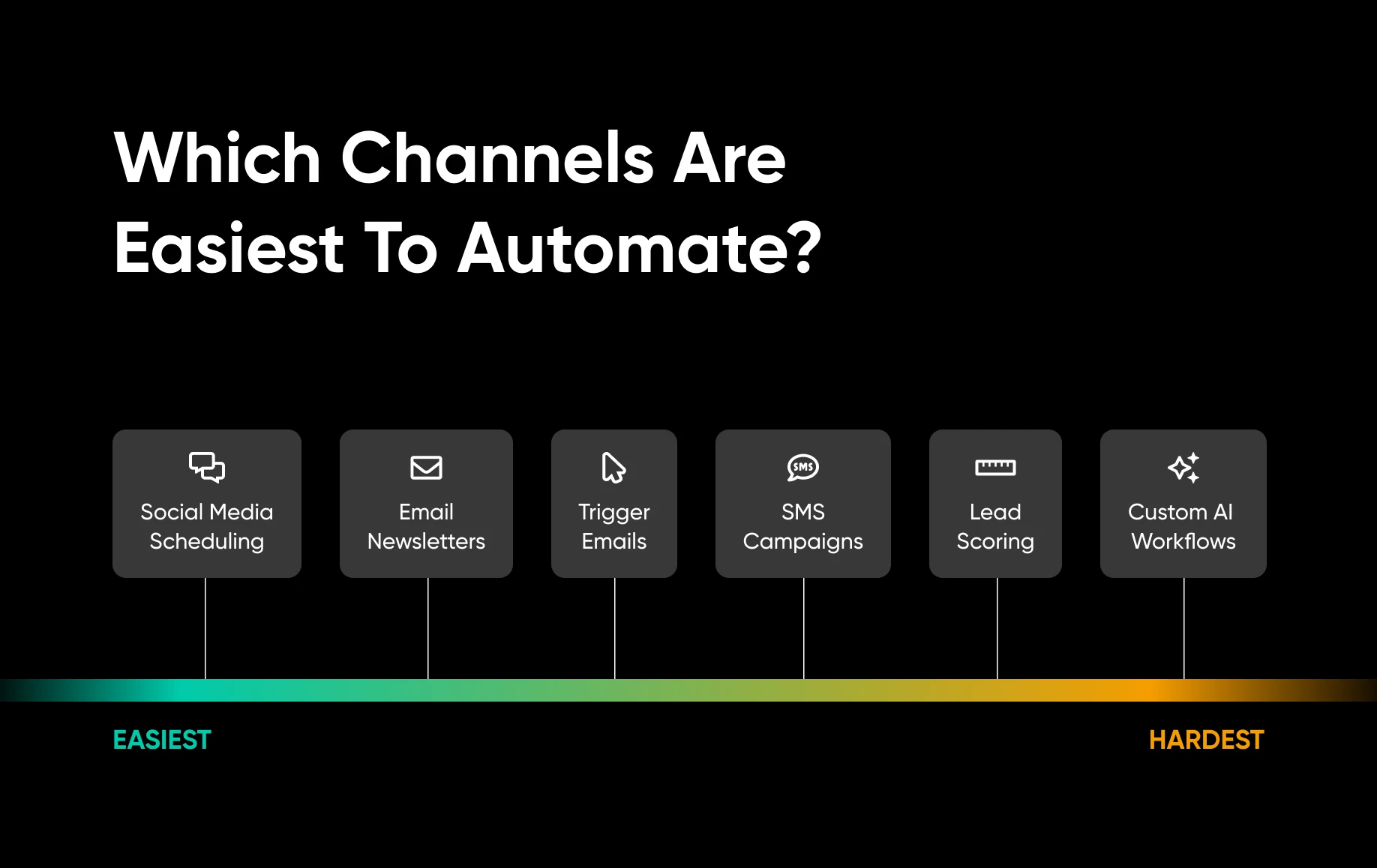
Of course, there’s time and technical skill to consider. Just because you dearly want to automate a workflow doesn’t mean it will be easy.
Luckily, there’s plenty of low-hanging fruit.
- Social media management is the most obvious entry point: Instead of posting everything by hand, you can use dedicated tools to create and queue a month’s worth of content in advance. This also allows you to publish when your audience is most active on each platform and to monitor incoming replies.
- Another easy option is email marketing: According to Act-on, around 7 in 10 marketers already use automation here.
- Automating lead scoring and audience segmentation takes a little more work: But it’s nothing too drastic. These automations can also save you SO much time in the long run.
Most email platforms have built-in automation options, such as autoresponders and sequence builders. Outreach templates might seem basic, but that’s another form of automation. For online store owners, it’s also pretty easy to set up automated abandoned cart emails.
Would you take “it depends” as an answer?
No, seriously. Your choice of automation tools depends on the channels you’re targeting, how technical you want to be, and what your budget will stretch to.
That said, there are some standout tools in each department:
- Zapier and Make for building connected workflows: Both platforms allow you to connect the apps you already use and create automated workflows, complete with AI.
- Mailchimp, MailerLite, and Klaviyo for email marketing: Mailchimp is the all-purpose king. MailerLite is a little more user-friendly. Klaviyo lets you build powerful automations based on user behavior.
- EZ Texting, SimpleTexting, and Klaviyo for SMS marketing: EZ Texting lets you build automated campaigns. SimpleTexting lets you compose messages faster with AI, while Klaviyo can build workflows for you.
- Socialbee, Buffer, and Sendible for social media posting: SocialBee has AI features for planning and creating content for multiple channels. Buffer is mainly a scheduling tool, and it’s super easy to use. Sendible is great for recycling content.
- Google Analytics, Whatagraph, and Supermetrics for analytics: Google Analytics is great for website metrics. Whatagraph and Supermetrics allow you to build automated reports.
You probably won’t need half of these apps. Maybe not even a quarter. But it’s nice to have options, right?
Just remember: only choose tools that help you achieve your automation goals. It’s way too easy to sign up for 10 subscriptions and barely use any of them.
How To Get Started: The 4-Step Plan
Okay, let’s condense everything we’ve talked about into an actionable plan.
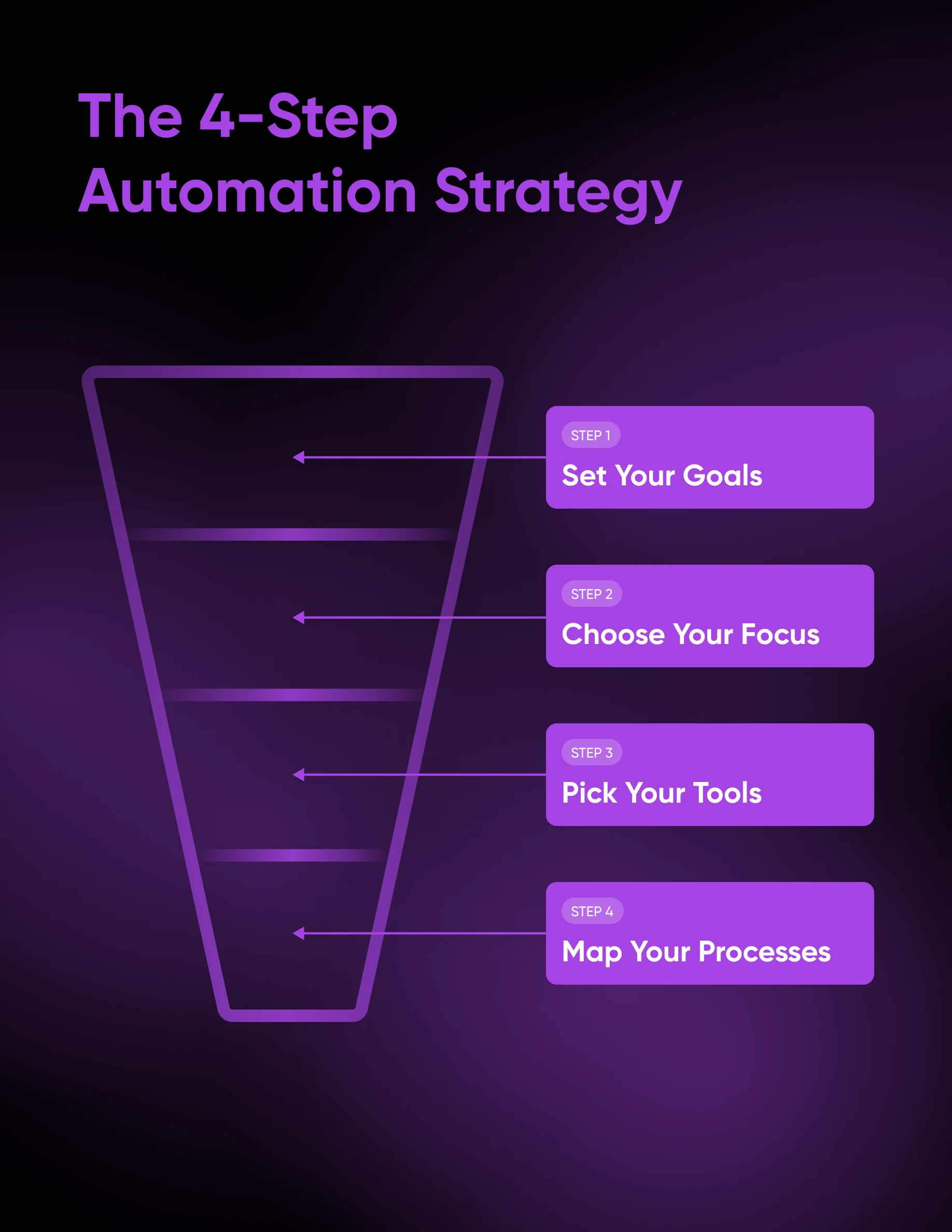
Step 1: Decide on Your Goals
Start with the outcome. In an ideal world, what would you like to achieve with your adventures in marketing automation?
Make sure your goals are specific, measurable, and likely to actually improve your business/ workday/life in some way.
Step 2: Choose Your Focus
Look at your freshly minted goal(s) and consider which type of marketing — or which individual tactics — are likely to move you toward that outcome.
This one can be tricky because it’s not always obvious which automations are going to work best for driving additional leads or improving conversion rates.
But you can make the choice easier by focusing on your current strengths. For example, if you generate a lot of business through email marketing, it would be worth doubling down on it.
If you really want to shortcut the decision-making process, just choose individual tactics and strategies that already work for others and align with your goals.
Step 3: Pick Your Tools
If you’ve really nailed the first two steps, this one should be fairly easy.
In most cases, specialized tools are the way to go. Custom workflows look cool on social media, but they take time and skill to build. Don’t bother; let someone else figure out the complicated stuff.
If possible, try to find a platform that can handle all your automation ideas within a specific field. Unless your name is Mr. Beast, one social media app should be enough. The same goes for every other category.
Can’t find what you need? That’s when you turn to tools like Zapier and Make.
Step 4: Map Out Your Processes
Whether you’re trying to automate an existing workflow or you’re starting from scratch, it’s important to think about how your automation will work.
Break it down into individual steps, as if you were teaching a work-experience kid. This type of instruction is exactly what AI tools need to perform well, and it will help you create your own automations.
Ready To Put This Show on the Road?
Clear direction is the secret to successful marketing automation. Your strategy should help you focus on the areas where you’ll see the biggest returns — in terms of money, time, and effort.
Just remember the key steps:
Once you’re ready to implement the plan, be sure to take us along for the ride. Our blog is full of useful guides on AI and automation, including:
DreamHost customers also get free access to useful AI tools, including our Liftoff and Remixer AI website builders. Both can help you design a better site and start attracting leads faster.
Sign up for one of our hosting plans today to give them a try!

[Download] 2026 Marketing on Autopilot
Stop Doing Marketing By Hand.
91% of marketers say automation helps them hit their goals. This 49-page ebook gives small business owners playbooks for email, SMS, social, paid ads, and analytics — running themselves while you focus on the work that actually moves the needle.
Get The Playbook
Did you enjoy this article?

 English
 Dutch
Dutch French
 German
 Italian
 Japanese
 Korean
 Portuguese
 Russian
 Spanish