
Search Engine Statistics 2026: Market Share, Volume & AI

Google held 89.9% of the global search market in September 2026, handles more than 5 trillion searches a year, and its advertising business brought in $294.7 billion in 2025. Yet 68% of US Google searches ended without a click in early 2026, AI Overviews appeared on about 48% of tracked queries by February 2026, and 15% of daily searches are queries Google has never seen before. Here are 50+ search engine statistics covering market share, Google dominance, search volume, mobile trends, AI impact, and alternative search engines for 2026.
Key Search Engine Statistics (2026)
- Google: 89.9% global market share in September 2026 (StatCounter)
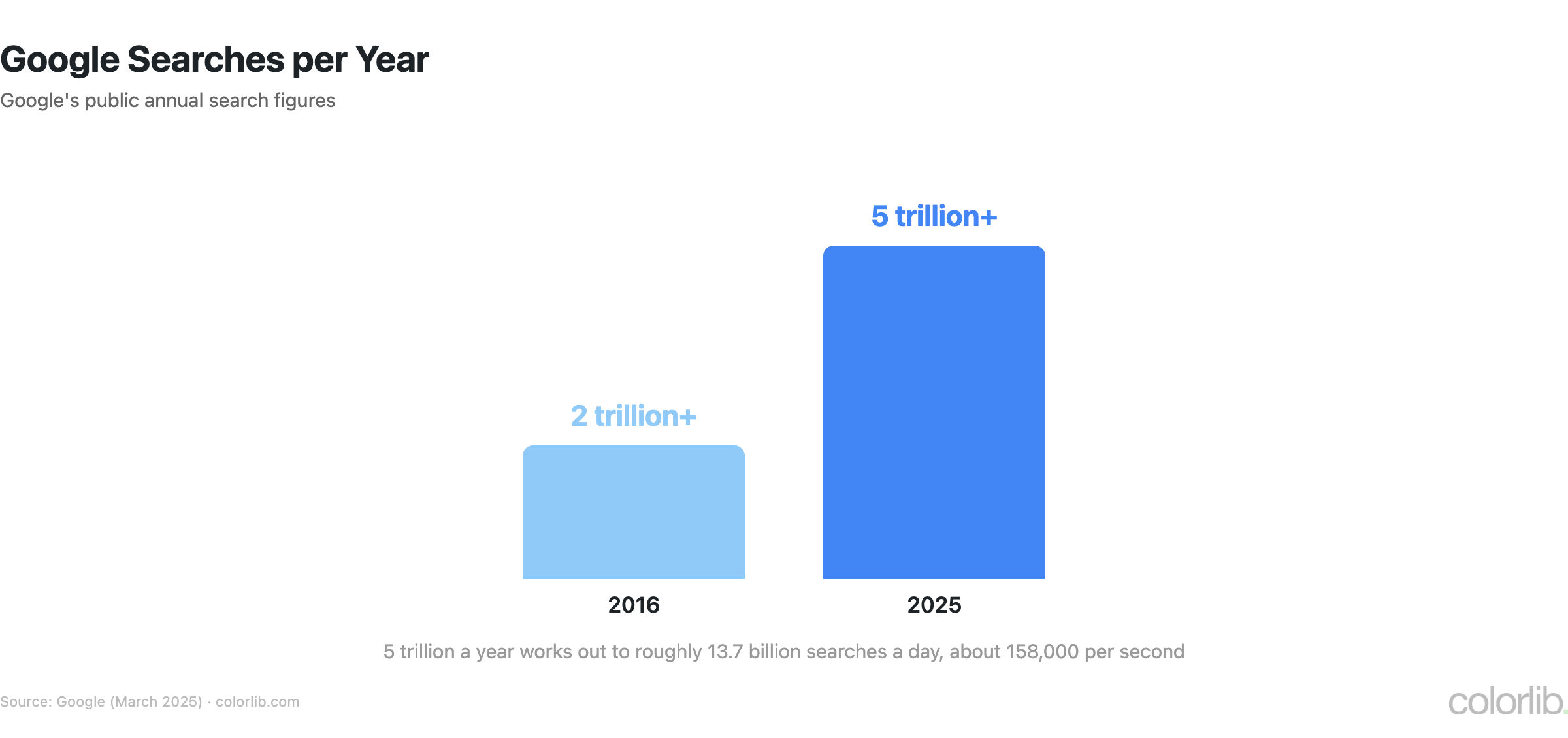
- 5 trillion+ Google searches per year, roughly 13.7 billion a day (Google)
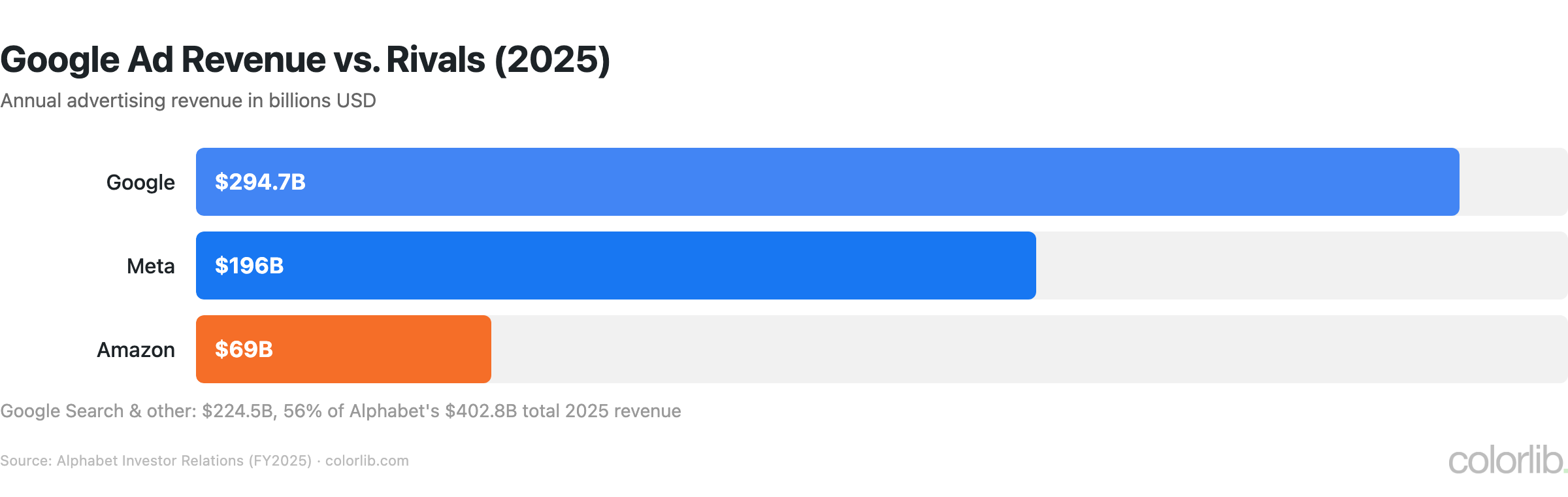
- Google advertising revenue: $294.7 billion (2025) (Alphabet IR)
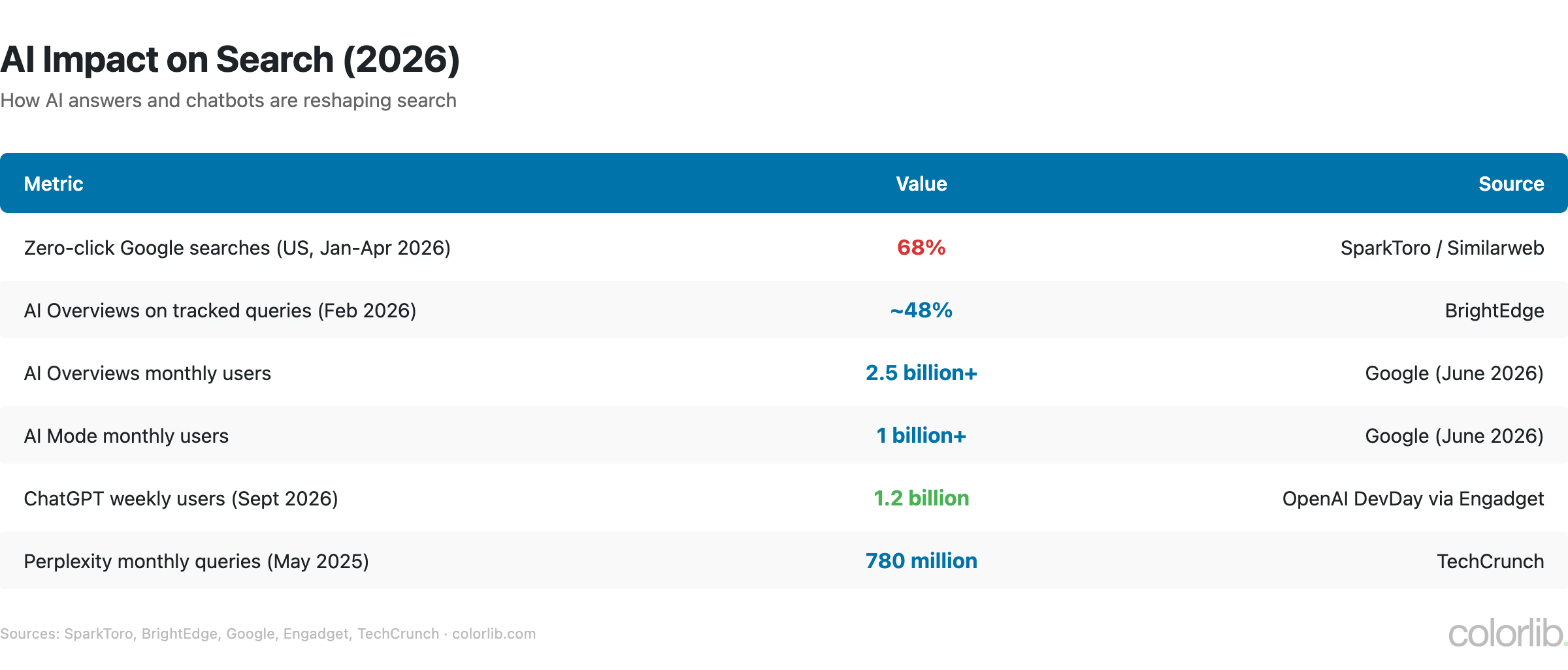
- Zero-click searches: 68% of US Google searches, January–April 2026 (SparkToro)
- AI Overviews on about 48% of tracked Google queries in February 2026 (BrightEdge)
- 15% of daily searches are completely new (Google via Search Engine Journal)
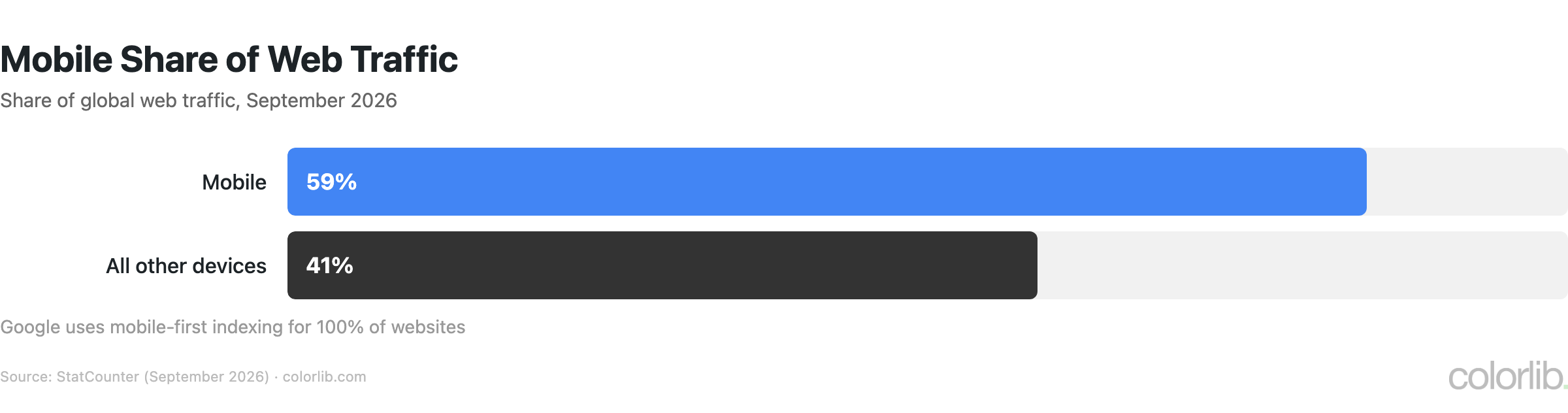
- Mobile: 59% of global web traffic in September 2026 (StatCounter)
Search Engine Market Share
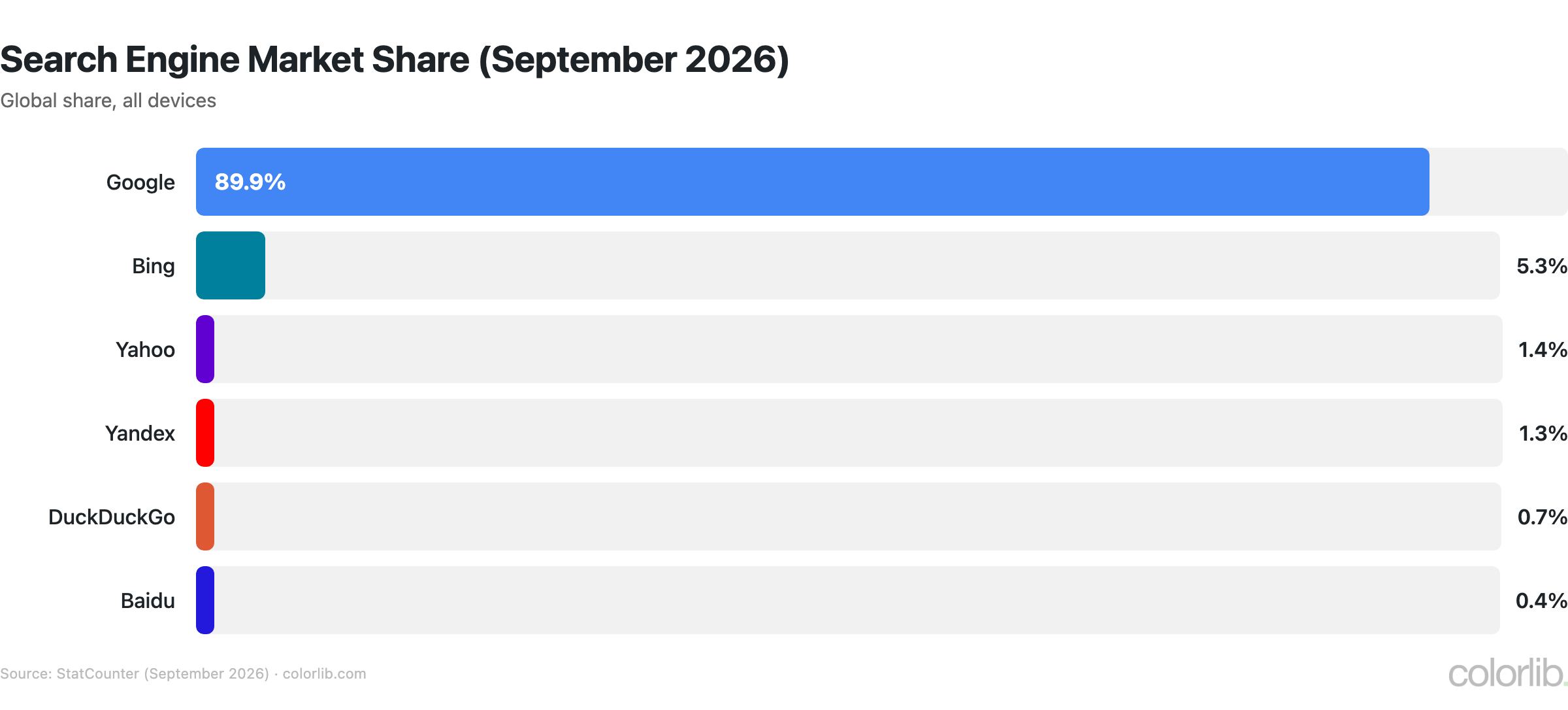
- Google’s 89.9% global share in September 2026 is close to the 90% level it has held for over a decade, though it has hovered around or just below 90% since October 2024
- Bing’s share has grown to 5.3% globally and 9.9% in the US (September 2026), up from about 3.4% globally in January 2024, driven by its Copilot AI integration and Microsoft Edge defaults
- DuckDuckGo holds 1.8% of US searches, appealing to privacy-conscious users, though its growth has stalled
- AI chatbots (ChatGPT, Perplexity, Claude) don’t appear in traditional market share data, but their reach is large: ChatGPT showed 1.2 billion weekly users at OpenAI’s DevDay in September 2026 (Engadget)
- For platform-level data, see our CMS market share analysis
Google Dominance Statistics
- Google’s advertising business brought in $294.7 billion in 2025, making it the world’s largest advertising platform — more than Meta ($196B) and Amazon ($69B) ad revenue combined
- Google Search & other accounted for 56% of Alphabet’s 2025 revenue ($224.5B), with YouTube ads (10%) and Google Network (7%) adding to the total
- Google handles roughly 158,000 searches every second, served from 35+ data centers across four continents
- Despite antitrust lawsuits, Google’s ~90% market share has barely moved — the DOJ ruling in August 2024 found Google holds an illegal monopoly, and the September 2025 remedies decision barred exclusive default deals but let Google keep Chrome
- Google paid Apple about $20 billion in 2022 to remain the default search engine on Safari and iOS, according to evidence in the DOJ case
Search Volume & Behavior
- 15% of daily searches are queries Google has never seen before, driven by evolving language, current events, and conversational search patterns
- Just over 44% of Google searches are for branded terms, and about a third are navigational — brand awareness feeds search demand directly (SparkToro/Datos, US data from 2023–2024)
- Just over half of Google searches are informational, while commercial research queries make up 14.5% and purely transactional queries under 1%
- The average Google search session lasts 76 seconds, and half of all sessions end within 53 seconds, indicating fast, focused search behavior
Mobile Search Statistics
- Mobile devices generated 59% of global web traffic in September 2026, making mobile optimization essential for search visibility
- Google uses mobile-first indexing for 100% of websites — your mobile site experience determines your rankings
- Nearly 65% of App Store downloads happen directly after a search, according to Apple — app store search is a discovery channel of its own
- For how mobile performance affects search rankings, see our digital marketing statistics roundup
AI & Zero-Click Search Statistics
- 68% of US Google searches ended in zero clicks in January–April 2026, up from about 60% in 2024 — users find answers directly on the SERP through knowledge panels, featured snippets, and AI Overviews
- AI Overviews appeared on about 48% of queries tracked by BrightEdge in February 2026, and Google says they reach more than 2.5 billion users a month, with AI Mode past 1 billion monthly users
- AI chatbots are growing fast — ChatGPT showed 1.2 billion weekly users in September 2026 — yet Google says its own query volume reached an all-time high in early 2026
- In Ahrefs’ 2017 study, a featured snippet earned 8.6% of clicks on average, less than the 19.6% for the result right below it, because the snippet often answers the query on the SERP
- The zero-click trend means SEO is shifting from “drive clicks” to “maximize SERP visibility” — brand awareness matters even without direct traffic
Bing & Alternative Search Engines
- Bing’s AI-powered Copilot integration and Edge defaults have lifted its share to 5.3% globally in September 2026, up from about 3.4% in January 2024, though it remains far behind Google
- DuckDuckGo’s growth has plateaued below 1% globally (0.7% in September 2026), suggesting privacy alone isn’t enough to challenge Google
- Yandex (70% in Russia) and Baidu (47% in China, per StatCounter) demonstrate that Google’s dominance is primarily a Western phenomenon
- New entrants like Brave Search (independent index) and Perplexity (AI-native search) represent the most innovative challengers
- For how search engines impact your website platform choice, see our CMS market share analysis
Key Takeaways
Sources
Frequently Asked Questions
How many Google searches per day?
Google confirmed in March 2025 that it sees more than 5 trillion searches a year, which works out to roughly 13.7 billion searches per day or about 158,000 per second. Its previous public figure, from 2016, was 2 trillion+ a year. Of these searches, 15% are queries Google has never seen before.
What is Google’s market share?
Google held 89.9% of the global search market and 85.2% in the United States in September 2026, according to StatCounter. The next largest competitors are Bing (5.3%), Yahoo (1.4%), Yandex (1.3%), DuckDuckGo (0.7%), and Baidu (0.4%). Google’s share has stayed near 90% despite AI chatbot competition and a 2024 DOJ antitrust ruling. For how this affects web publishing, see our SEO statistics roundup.
What are zero-click searches?
Zero-click searches are queries where the user finds their answer directly on Google’s results page without clicking through to any website. This includes knowledge panels, featured snippets, AI Overviews, calculator results, weather, sports scores, and more. SparkToro’s 2026 study, based on Similarweb data, found that 68% of US Google searches ended without a click in January–April 2026, up from about 60% in 2024. The trend is accelerating as AI Overviews now appear on roughly half of tracked queries.
Will AI replace Google search?
Not in the near term. ChatGPT showed 1.2 billion weekly users in September 2026, but Google still holds about 90% of the search market and says its query volume reached an all-time high in early 2026. Google itself is integrating AI through AI Overviews (2.5 billion+ monthly users), AI Mode and Gemini. The more likely outcome is that search evolves to blend traditional results with AI answers, rather than AI fully replacing search engines. For related digital trends, see our digital marketing statistics report.
Was this article helpful?
YesNo

 English
 Dutch
Dutch French
 German
 Italian
 Japanese
 Korean
 Portuguese
 Russian
 Spanish