
Time Management and Productivity Tips for Entrepreneurs

Being your own boss is freeing.
Until your to-do list never stops growing.
Chances are, you’re just like most other small business entrepreneurs, who spend an average of 36% of their work week on administrative tasks!
That’s a lot of time you could be focusing on work that actually grows your business.
Successful entrepreneurs don’t just work harder — they work smarter by designing systems that protect their time and energy.
From time-blocking and task prioritization to delegation and energy mapping, the following productivity strategies will help you take control of your schedule instead of letting it control you.
Boundaries, Boundaries, Boundaries
Work can already bleed into your personal life, but it’s often worse for new entrepreneurs.
Here’s how to set realistic boundaries and hours for long-term productivity.
Define Your Core Work Hours
Decide when your workday starts and ends, and treat these hours as non-negotiable.
Consistency here builds structure, helps you form productive habits, and also trains your clients and staff to respect your schedule.
Use a Dedicated Workspace
Physical separation of work and personal life reinforces boundaries both outwardly and in your own brain.
A dedicated workspace or even just your own desk in the corner of the living room at home allows you to mentally “clock in” and “clock out.”
In other words, avoid working from the couch, bed, or dining table. Stop it — we see you!
Set Digital Boundaries
Technology has really helped blur the line between work and life.
Don’t let it.
Turn off notifications for work emails, messaging apps, and project management tools outside of work hours.
Use features like “Do Not Disturb” on your phone, put time limits on your work-related apps, and set up email auto-responses to protect your personal time.
Having a professional email address and social media accounts that are separate from your personal ones can really help reduce the temptation to check work messages and get sucked back in the evenings or on weekends.
Communicate Your Availability
Clear communication only reinforces your boundaries.
Don’t shy away from reminding clients, vendors, and team members about your working hours, and how that impacts response times.
One way to gently nudge folks who reach out outside of this timeframe is with email auto-responders.
For example, a friendly but firm auto-reply might look like: “Thank you for your email! I respond to messages between 9 a.m. and 5 p.m., Monday through Friday. I’ll get back to you during those hours.”
This sets expectations, but also reduces the pressure you put on yourself to respond immediately outside of your work hours.
When in doubt, overcommunicate.
Learn To Say No
Every “yes” comes with a cost: your time, your energy, or your focus.
To protect all of these things, learn to politely decline meetings and any other tasks that don’t move the needle or align with your business priorities.
Over time, consistently saying no to low-value requests reinforces your boundaries, strengthens your own productivity, and may even set an example for those around you who are struggling to make the impact they want.
Bonus Tip: Start Small and Adjust
Holding boundaries can be one of the hardest things you’ll have to do as an entrepreneur, even when you know exactly why they matter.
You don’t have to be perfect from day one.
Start by setting just one or two of your favorite rules, then gradually expand on those as your stick-to-it muscles get stronger.
Create Systems That Scale
It might seem like it’s working fine to just wing it for a while — it can even be a little thrilling!
But once you really get into the swing of things, it will be extremely hard to go back and create proper processes that free you from tedium and help your business grow.
Build SOPs for Consistency
Standard operating procedures (SOPs) document how recurring tasks should be completed.
These step-by-step guides ensure that everyone on your team can execute tasks the same way every time.
For example, you might create SOPs for:
- Equipment maintenance
- Invoicing
- Issuing returns to customers
- Opening and closing down your office, shop, store, etc., every day
SOPs save time, reduce mistakes, maintain quality as your business scales, and free you from the shackles of micromanagement. That’s why you should be thinking about these as soon as you consider making your side hustle legit.
Set Up Project Management Systems
Are you relying on scattered notes, spreadsheets, or memory to get sh*t done?
Then you need a project management system that keeps everyone’s tasks, deadlines, and responsibilities in one place.
Tools like Trello, ClickUp, and monday.com let you track progress, assign tasks, and collaborate efficiently.
This makes it easy to spot bottlenecks, delegate work, and set up a blueprint for eventually scaling without descending into chaos.
Adopt Business Automation
Automation saves hours each week, reduces errors, and ensures consistent execution.
Simple, repetitive tasks that you can put on autopilot may include:
- Adding people to your new subscriber email marketing sequence when they enter their email address into your website.
- Sharing new blog posts from your website to social media.
- Setting up your invoicing platform to send reminders when outstanding payments are past due.
Everyday Productivity Hacks
Administrative tasks like invoicing, re-upping supplies, and so on are eating up your day-to-day?
It’s time to talk about productivity upgrades.
Prioritize With the Eisenhower Matrix
The Eisenhower Matrix is a simple but powerful tool to sort tasks by urgency and importance.
To use it, divide your to-do list into four categories:
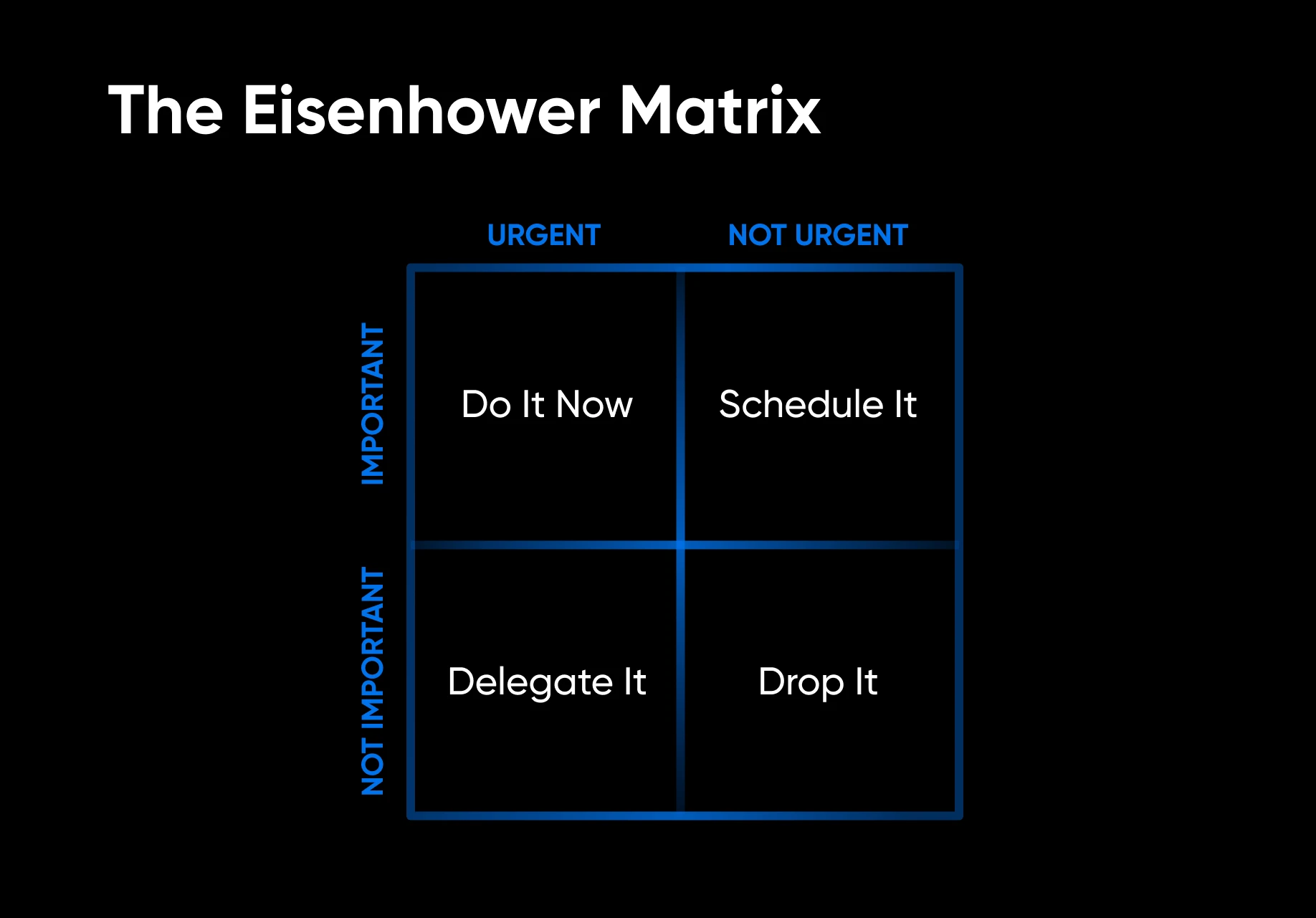
Focus first on the important tasks. These should move your business forward. Urgent but less important tasks can be delegated or scheduled later. Tasks that are neither urgent nor important should be minimized or, honestly, ignored.
For example, responding to a low-priority email might feel urgent, but it’s actually the hard work of digging in and creating a new product that’s truly important.
Plan Your Day in Time Blocks
Instead of reacting to everything as it comes up, we strongly recommend trying to schedule dedicated blocks for different activities throughout your day.
For instance, reserve 9 a.m. to 11 a.m. for strategy and creative work while you’re fresh, 11 a.m. to 12 p.m. for emails while you’re noshing, and 1 p.m. to 3 p.m. for client meetings or project execution.
Time-blocking reduces context switching, which is a major drain on focus. When you work in blocks, your brain can stay immersed in a single type of work, boosting productivity and quality.
Practice Theme Days
Let’s take the time blocking a step further and apply it to entire days.
For example, “Marketing Mondays,” “Finance Tuesdays,” or “Content Creation Wednesdays.”
Theme days allow you to dive incredibly deep into one area without interruptions, making it easier to complete complex tasks that otherwise would drag on for weeks between distractions.
Adopt a “Top 3” Daily Rule
Each morning, identify the three tasks that absolutely must be completed that day. These should be high-impact items that directly contribute to your goals.
Start your day by tackling these tasks first, before things like emails and calls sap all your energy.
Even if unexpected events arise, with this strategy, you’ve accomplished the most critical work.
Use Micro-Deadlines
Large projects can feel overwhelming, which makes them fall victim to procrastination.
Micro-deadlines break scary projects into smaller, manageable steps, so you can enjoy consistent momentum.
For example, instead of waiting until the end of the month to complete a marketing campaign, set micro-deadlines:
- Week 1: Research and outline content strategy
- Week 2: Draft posts
- Week 3: Schedule content and finalize visuals
- Week 4: Review and launch
This approach gives you a much more approachable roadmap for progress. Each one gives you a small win to build on.
Steal the Postmortem From the Software Pros
In the tech world, postmortems are a standard practice after a project is complete to review what went right and what went wrong.
Entrepreneurs can apply the same principle to their own tasks.
After finishing a manufacturing run or a marketing campaign, take a step back and ask: What went well? What caused hiccups? What can I do differently next time?
Here are some tricks for using the postmortem strategy to optimize processes, reduce wasted time, and improve productivity.
Track Your Time
Ever run late to anything?
Of course you have.
We as humans are often kinda bad at estimating how long it’ll take to do something.
Use a tool like Toggl or Clockify to monitor where your hours go.
You may be surprised to find that meetings, social media, or administrative tasks consume way too many of your work hours. Tracking your time gives you the data to reclaim wasted periods and focus on high-impact activities.
Reflect Weekly
Set a meeting with yourself each week to review accomplishments, challenges, and plans for the next week.
Which tasks drove results? Which did little more than drain your energy? Regular reflection keeps you aligned with long-term goals and ensures your efforts match your priorities.
Use Energy Mapping
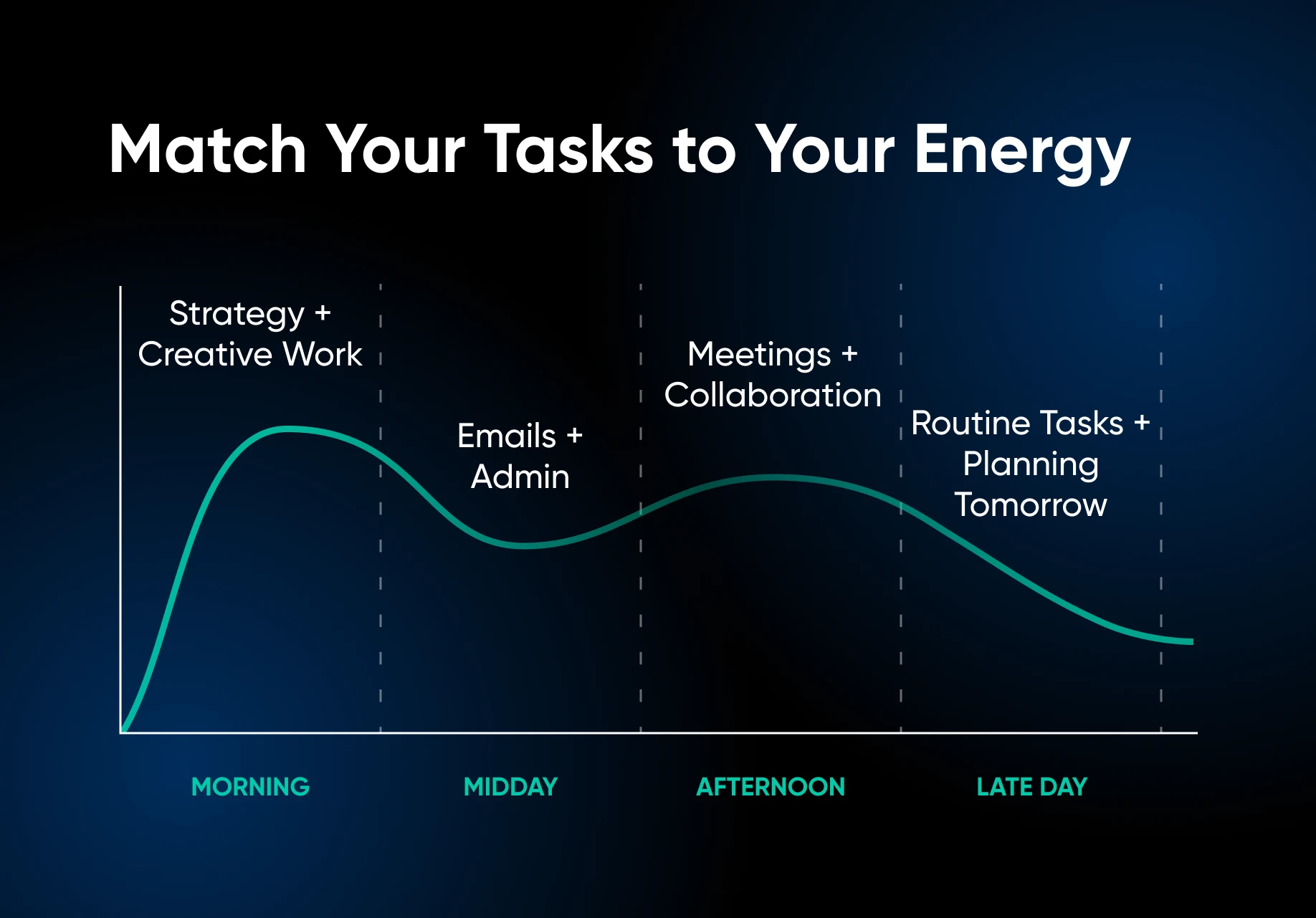
Pay attention to your natural energy rhythms.
Track when you feel most alert, creative, and focused during the day — time tracking can help here!
Schedule demanding tasks during peak energy hours, and reserve routine or administrative work for low-energy periods.
Avoid Burnout
Speaking of…
Long hours, constant decision-making, and high stakes can quickly lead to burnout if you don’t manage your energy and workload.
Delegate or Outsource Early
Many entrepreneurs fall into the trap of doing everything themselves.
But trying to handle every task — administrative work, bookkeeping, social media, and so on — can drain your energy and even slow growth.
In fact, one study found that 82% of entrepreneurs who identified themselves as great delegators observed revenue and profit increases after two years in business, while only 66% of self-identified “non-expert” delegators saw the same.
Identify tasks that don’t require your unique expertise and delegate them to team members, virtual assistants, or freelancers.
The more you delegate, the more time you have to focus on high-value, revenue-generating activities like client work, product development, or strategic planning.
Limit Multitasking
It might feel productive to juggle multiple tasks at once, but multitasking actually reduces efficiency and increases errors.
Instead, go the other direction entirely and pick one task, set a clear goal, and complete it before moving to the next.
For example, dedicate 90 minutes to writing a proposal without checking email or messages. Then, shift to the next priority, such as returning client messages. This approach improves focus, speed, and the quality of your work.
Take Strategic Breaks
Working nonstop isn’t sustainable. Not for long, anyway.
Short, scheduled breaks can actually boost focus and creativity. For most people, energy naturally dips every 90 to 120 minutes, per your ultradian rhythms. Use these periods to step away from your desk, stretch, take a short walk, or meditate.
The Pomodoro Technique is a popular method: work for 25 minutes, then take a 5-minute break. After four cycles, take a longer 15- to 30-minute break. While it may seem counterintuitive to take so much time “off” work, this strategy is actually great for keeping you consistent and preventing mental fatigue.
Work Better, Not Longer With Sustainable Systems
Productivity really isn’t about working more hours — it’s about making the hours you already have count.
Spend less time in a state of chaos and up your efficiency when you first set clear boundaries: Define work hours, create a dedicated workspace, and turn off notifications outside of work.
Communicate your availability so clients and teammates know when to expect responses.
Next, structure your workflow using tricks like time-blocking, theme days, and a daily priority list (cap it at three!) to focus on high-impact work instead of reacting to everything at once.
Use prioritization tools like the Eisenhower Matrix, and support your workflow with SOPs, automation, and project management systems to reduce repetitive tasks and stay organized.
Track your time and align tasks with your natural energy levels — handling deep work during peak focus hours and lighter tasks when energy dips.
Finally, prevent burnout by delegating, avoiding multitasking, and taking regular breaks.
The point isn’t to achieve perfection. The goal is to build a system that works for your business, your energy, and your life. Start with one thing. The rest follows.

[Download] 2026 From Side Hustle to Full-Time Business
Are You Ready for Takeoff?
Entrepreneurs spend 36% of every work week on admin tasks alone. This 46-page ebook gives small business owners a complete playbook for going full time — financial readiness, legal setup, online presence, time management, marketing, and hiring.
Get The Playbook
Did you enjoy this article?


 English
 Dutch
Dutch French
 German
 Italian
 Japanese
 Korean
 Portuguese
 Russian
 Spanish